


We’ve never known more about what prospective customers are doing.
We know who visits our websites, what content they read, which emails they click, what topics their companies appear to be researching and when someone visits a review site. Sales-call recording tools can tell us which problems prospects mention, what competitors come up and what objections appear during a deal.
We’ve used these signals to help sales determine which prospects and accounts are worth following up with, and when.
But there is a problem with this approach.
Behind every search for a product or service is a moment when someone begins struggling to make the progress they want. Something has changed enough that the status quo no longer works, launching them into a search for a better way forward.
Yet despite all the buyer data companies collect, most have never done the work to understand what those struggling moments actually are.
Instead, they infer why customers buy from the evidence available to them.
· A prospect clicked three articles about a problem, so the problem must be important.
· An account is surging on a category term, so it must be in market.
· A buyer tells a salesperson that efficiency is a priority, so efficiency becomes part of the company's messaging.
None of those conclusions are wrong, and good discovery calls can provide insight into what buyers care about. But they rarely give you the full picture of what caused the customer to start looking in the first place.
By the time sales enters the conversation, the buyer may already have defined the problem, decided what a solution should look like and begun comparing vendors.
If you accept that framing without understanding the circumstances that created the need for change, you risk competing on features or entering an RFP where the terms have already been set. You may also lose to the most common competitor of all: the status quo, because you never understood the problem the buyer was actually trying to solve.
The more interesting question is what happened before the customer ever wanted to talk to sales. What changed in their world that created the need to make progress, and why did it become important enough to act on now?
Why Most Companies Never Find Out
There are understandable reasons companies rarely get that far.
The first is that it’s easier to rely on the data they already have than to go back and reconstruct buying decisions with actual customers. Customer interviews take time, and some companies are surprisingly protective of those relationships.
I once worked in a sales capacity with a firm that wouldn’t let me talk to any of its existing customers, even though those conversations could have helped me understand why they bought, find more companies like them and potentially ask for referrals.
The second reason is that conducting a useful customer interview is a specialized skill. You can’t simply ask, “Why did you buy?” and expect an accurate reconstruction of the decision.
People rationalize decisions after the fact, forget important details and compress months of events into a tidy explanation. The interviewer has to know how to work backward, establish a timeline, probe what changed and keep digging until the circumstances surrounding the decision become clear.
Without that research, companies understandably fill in the gaps with the evidence they already have.
A prospect clicked three articles about a problem, so the problem must be important. An account is surging on a category term, so it must be in market. A buyer tells a salesperson that efficiency is a priority, so efficiency becomes part of the company’s messaging.

A better way to understand why customers change
Understanding the struggling moment requires looking beyond what customers say they wanted and reconstructing the circumstances that caused them to act.
That is the premise behind Jobs to Be Done.
Bob Moesta, one of the architects of the framework, describes the point at which customers begin to move as a "struggling moment." As he told us on the SaaS Backwards podcast, "Without a struggling moment, there's no energy for change."
Jobs to Be Done asks companies to reconstruct what caused that energy to appear. What changed? Why did the customer act then rather than six months earlier? What made the existing situation less acceptable? What attracted the customer to a new approach, and what anxieties or habits almost kept them from changing?
This is different from asking customers which features they wanted or what pain points they experienced. It is an attempt to understand the circumstances that caused action.
Ten good interviews can begin to reveal recurring pathways.
One group of customers may have changed after acquisitions created operational complexity. Another may have acted after new executives arrived with different expectations. Others may have grown until existing processes could no longer keep up.
Once those pathways emerge, the next step is to look backward and ask which of those changing circumstances would have been visible before the customer began looking for a solution.
Suppose a customer explains that rapid growth eventually overwhelmed a process that had worked fine when the company was smaller.
Looking backward, you might discover that the company had increased operations headcount by 35 percent, repeatedly posted the same jobs and hired a new CFO six months before entering your pipeline.
One example proves nothing. If similar patterns appear across several customers, however, you have the beginnings of a hypothesis worth testing.
AI creates a new way to use what you learn
Understanding these pathways has always been useful for finding potential buyers. If customer research tells you that a particular problem causes people to enter the market, you can create thought leadership around that problem, distribute it broadly and use engagement to identify people and companies for whom it resonates. In effect, you put the problem into the market and see who responds.
What has been much harder is reversing the process.
A researcher can study a handful of companies in detail, but no marketing or sales team can continuously examine thousands of prospective companies for the specific changes that might indicate one of those problems is beginning to emerge.
Monitoring job postings, earnings calls, SEC filings, executive changes, acquisitions, customer reviews and company announcements across an entire market simply requires too much human effort.
AI changes the scale at which that research can be done.
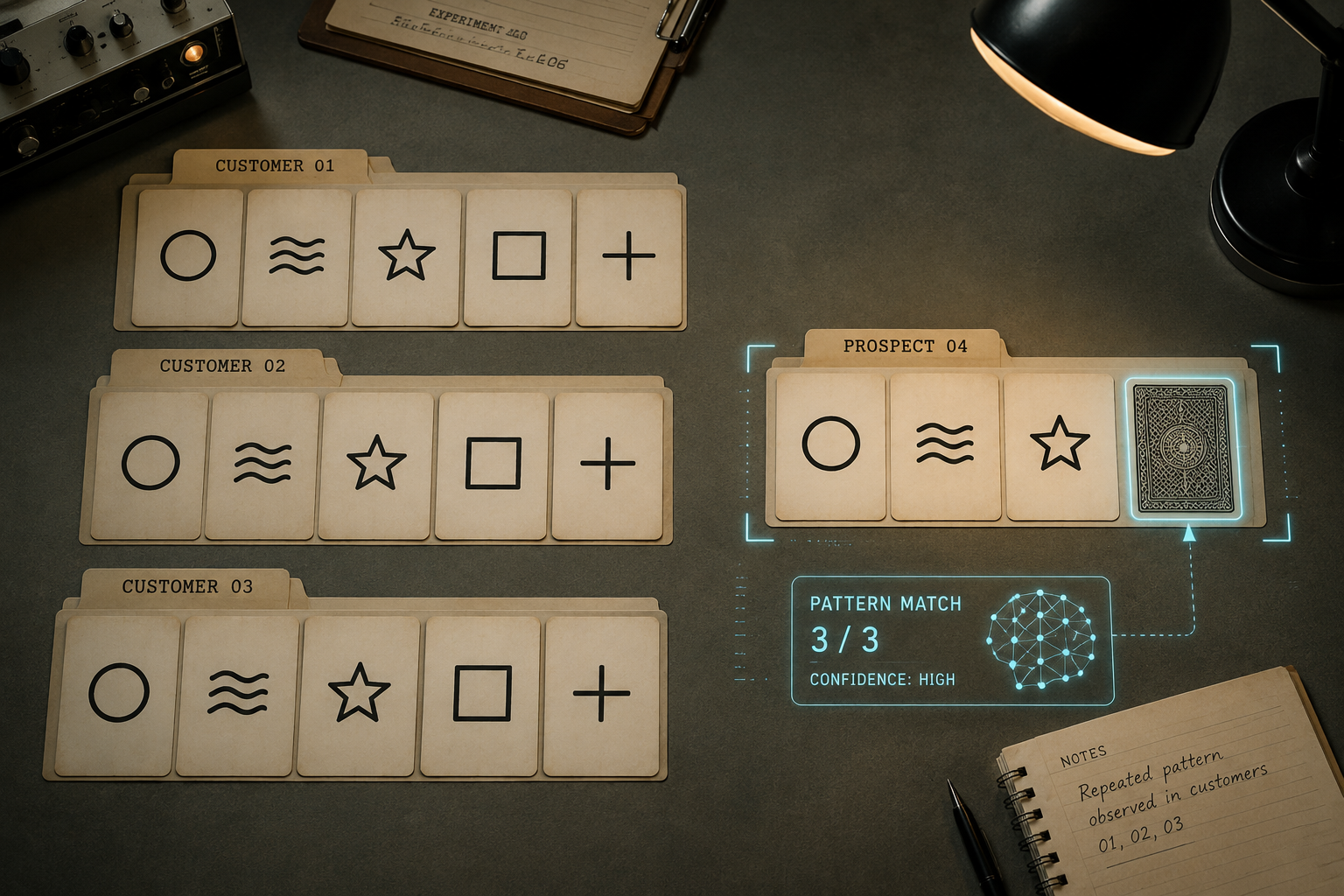
A company can take the pathways uncovered through customer research and build an AI agent specifically designed to look for evidence that similar circumstances are developing elsewhere. Instead of waiting for someone to engage with our content or begin exhibiting conventional intent, we can potentially identify companies where the conditions that preceded our customers’ struggling moments are beginning to appear.
This is different from monitoring the generic triggers available to everyone. Most companies can buy the same intent data, funding announcements, executive changes and account intelligence.
If every competitor receives an alert that Acme Corp is researching “revenue intelligence software,” the signal provides little competitive advantage because everyone has been told that the race has started.
A proprietary signal begins with something competitors don’t have: your understanding of why your customers change.
AI may even help uncover patterns you didn’t know to look for. Perhaps several of your best customers hired a new finance executive, expanded geographically and changed an important technology within nine months of entering your pipeline. Customers may never mention that combination because they don’t think of those events as the reason they bought, but the pattern may be an observable precursor to the circumstances that eventually produced their struggling moment.
It may also be meaningless, which is why it needs to be tested against historical opportunities and companies that never bought. If the pattern repeatedly precedes the same struggling moment, however, it becomes something worth monitoring.
The opportunity AI creates, then, isn’t simply a better way to identify people already demonstrating intent. It gives us a practical way to search thousands of companies for the conditions that may create intent before the buyer begins searching for a solution.
The competitive advantage is knowing what to teach the AI
The goal isn't to turn these signals into another lead-scoring system. An executive change, hiring spike or acquisition doesn't prove that a company has the problem you solve. It gives you a reason to investigate.
If an AI agent identifies a company because several conditions resemble a pathway found among your customers, the next step is to understand what is actually happening, whether those conditions could create the problem you solve and who inside the organization would be likely to care.
The signal should start the research, not the sequence.
First-party behavior can then add another layer of evidence. If several people at the account begin engaging with content about the problem you believe may be developing, those clicks become more meaningful because they support an existing hypothesis rather than creating one.
This takes more work than buying another source of intent, but that is also what makes it difficult to copy. As AI agents become available to everyone, the technology itself will provide less competitive advantage.
The companies that benefit most may be those that understand why their customers buy well enough to teach AI what to look for.
That's one of the things we're now exploring in our GTM Analysis. We'll look at the problems your best customers are trying to solve and the observable signals that could indicate when those same problems are developing elsewhere. If you'd like us to see what an AI agent might look for in your market, take us up on the free analysis.


