


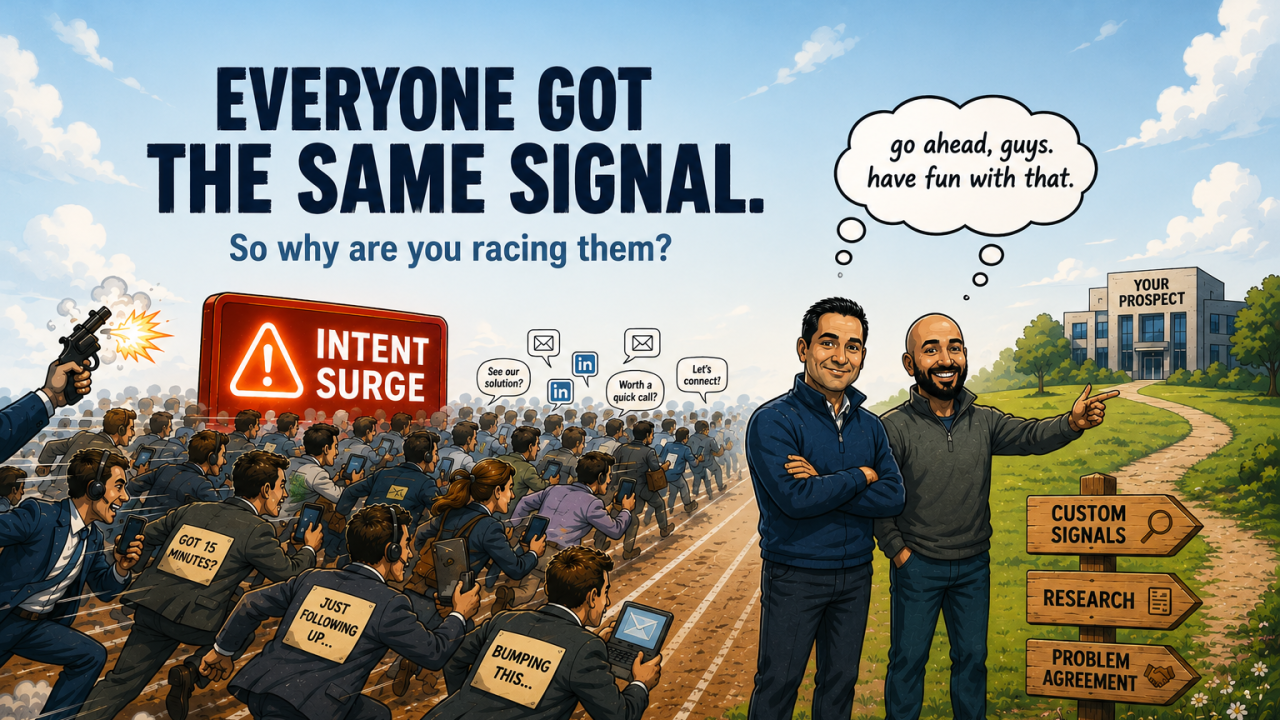
Third-party intent data became popular for a good reason.
Buyers were doing more of their research online and through social networks before talking to sales, and companies wanted to identify intent early enough to get into the buying process before their competitors did.
By 2020, TOPO’s Intent Data Market Guide reported that 62% of companies were already using at least one intent-data solution, up from 28% just two years earlier.
For a while, that was a genuine advantage.
If you knew an account was suddenly consuming more content around ERP, cybersecurity, data infrastructure or another category tied to your product, you knew something a rep working from an ICP list and a phone number didn’t.
The trouble is that useful technology rarely stays exclusive for long. Intent data has become part of the standard B2B stack, so competing vendors can now be alerted to the same company moving into a category at roughly the same time.
And that assumes the activity represents buying intent in the first place.
There’s a fairly big leap between people at an account researching a topic and that company actively evaluating products.
Even when an intent platform combines multiple searches and identifies unusual activity around related topics, what you really know is that the account is paying more attention to the subject than usual. You don't necessarily know why.
They could be evaluating products, trying to understand a regulation, researching a competitor, preparing a presentation or simply learning about something relevant to their jobs.
That doesn't make the signal useless. It makes “intent” a stronger word than the underlying behavior may justify.
You may have spotted something worth investigating, but you don't necessarily know the account is shopping. And even if it is, the advantage shrinks considerably if twenty competitors received the same alert.
The problem isn't the data. It's what we do with It.
Third-party intent can still help narrow a large market down to ICP accounts that appear to be paying attention to a problem you solve. That's considerably better than spraying outbound at every company matching your firmographics.
What went sideways was treating the signal as though the account had raised its hand.
Amos Bar-Joseph, CEO of Swan AI described in a recent Fireside Chat that the old ABM response during our recent discussion this way: “we have a signal. Let’s just try to get a meeting.” Too often that became a “20 step sequence because they showed intent on a specific topic online.”
An intent spike appears, the account gets routed to sales, and suddenly everyone behaves as though the buyer asked to be called. But all you really know is that something might be happening.
And buyers aren't particularly receptive when we get that wrong.
Demand Gen Report, citing a Gartner survey of 632 B2B buyers, reported that 73% actively avoid suppliers that send irrelevant outreach, while 61% prefer an overall rep-free buying experience. Gartner analyst Robert Blaisdell summarized the consequence pretty well: “Bad prospecting actively damages relationships with potential customers.”
So third-party intent hasn't become worthless. We've simply been asking it to tell us more than it actually knows.
A surge can tell you an account deserves attention, but it cannot tell you why the activity is happening, whether the company has decided to change anything or whether anybody there wants to hear from your BDR tomorrow morning.
By the Time They Show Intent, You May Already Be Too Late
Even when the signal is right, another problem remains: it may arrive after the competitive advantage has disappeared.
During a recent ABM webinar, Ken Lempit, president of Austin Lawrence Group, used the example of a food manufacturer suddenly showing strong ERP intent. Every ERP vendor watching the same category can potentially see the opportunity developing and start calling.
That creates a perverse incentive. If everyone receives the signal at roughly the same time, the natural response is speed to lead: get the account to a BDR, launch the sequence and make contact before the competition does.
It may make perfect sense from the seller’s perspective, but from the buyer’s perspective it means a burst of calls and emails from vendors they never asked to hear from, all racing to be first.
Sangram Vajre, Co-founder and CEO of GTM Partners, explained why timing matters when he said that “when you are first to market, your win rate dramatically increases.” But being first to contact someone isn't necessarily the same as being first to help them understand the problem.
If everybody discovers the account is shopping at roughly the same time, third-party intent may keep you from missing the opportunity, but it doesn't necessarily give you an advantage. In fact, it can push you into the same race as everyone else, using the same signal to justify the same outreach that buyers are increasingly trying to avoid.
Which raises a much more interesting question:What could you know before the buyer begins researching your category at all?
We’re digging into this exact problem in an upcoming GTM roundtable—how to identify buying conditions earlier, use AI without turning it into more spam, and give sales better reasons to engage. If you’re wrestling with the same thing, you’re welcome to join us.
Look for the Conditions That Create the Need
Bar-Joseph describes this as finding “alpha” in GTM.
Instead of relying only on signals available in standard B2B databases, look for observable conditions that correlate with the problem your product solves.
He gave an example from a Swan customer serving the real-estate market. The company monitors municipal records for increases in evictions at individual buildings because it has learned that rising eviction volume creates operational complexity its software can address.
That means it doesn't have to wait for a property manager to start researching software. It can see evidence that the problem itself may be developing.
Amos said the customer has seen strong reply rates, meeting conversion and win rates because its outreach is connected to a real business condition rather than a generic category-interest score.
The same idea can work in other markets. Hiring patterns, regulatory filings, acquisitions, executive changes, new facilities, funding events or industry-specific public records may reveal conditions that precede the need for your product.
These aren't universal intent signals that everyone can buy.
They are hypotheses about what tends to happen before your customers need you, which is precisely why they can create an advantage.

A Trigger Should Start the Research, Not the Sequence
There is one important catch. Finding a better signal doesn't mean replacing your Bombora-triggered sequence with an eviction-triggered sequence.
A trigger tells you something may be happening. It doesn't tell you whether the company recognizes the problem, who cares about it internally or whether anyone intends to buy something.
That's where the research starts.
Third-party intent can help marketing narrow the market, while custom signals can identify companies where a specific problem may be developing.
You can then use problem-oriented content to get in front of those accounts and see whether buyers engage. When they begin visiting relevant pages, attending events, consuming content or otherwise interacting directly with you, first-party intent can help sales decide where its prospecting time is best spent.
Even then, the next move doesn't have to be “Can I get 30 minutes on your calendar?”
Lempit made the point during the webinar that a trigger might lead to useful content, research, an invitation to a relevant discussion or something else that helps the buyer make progress.
The goal isn't to discover the signal first so you can sell first. It's to discover it early enough to be useful before everybody else starts selling.
Know Why They Might Shop Before They Start Shopping
Third-party intent still belongs in the toolkit, but it cannot reliably create differentiation on its own. If several competitors see the same surge and respond with roughly the same outreach, everybody arrives at the opportunity at roughly the same time while the buyer wonders why the entire category suddenly decided to call on Tuesday morning.
The bigger opportunity is to understand what happens before your customers start shopping: the operational change, business event or struggling moment that creates the need in the first place.
That requires more work than buying another intent feed. You have to understand why customers buy from you, identify observable conditions that tend to precede that need and test those assumptions against what happens in the market.
But that's also why your competitors are less likely to have the same signal.
The next advantage in intent may not come from knowing who is shopping.
It may come from understanding why they're likely to need to shop before they know it themselves.
If you’re wondering what those signals might look like in your own market...
...that’s one of the things we work through in our complimentary GTM Analysis.
We look at your buyers, current GTM motion and public data to identify custom triggers that may reveal a buying window before conventional intent shows up, along with the messaging and engagement strategy that should follow.
Take us up on a complimentary GTM Analysis →
No obligation afterward.


