


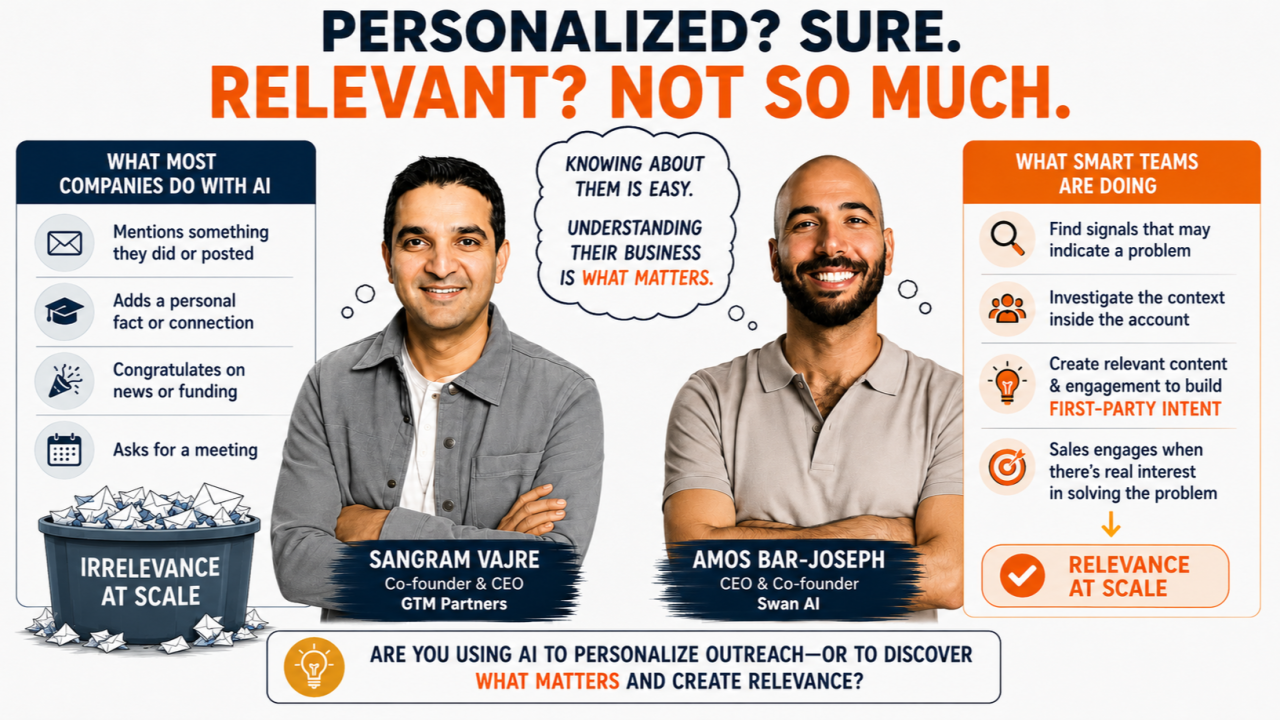
For a long time, the Predictable Revenue model worked. Marketing generated clicks, SDRs worked large lists through standardized sequences, and AEs closed enough of them to justify the machine.
As those tactics became less effective—buyers stopped responding because they knew a content download would earn them a sales call—ABM offered a sensible alternative: stop treating every company that fit your ICP as an equally good prospect, concentrate your resources on the accounts that mattered most, and find more relevant ways to engage them.
And for a while, the technology kept making that approach better.Products like Bombora gave marketers third-party intent data that could identify accounts showing unusual interest in topics related to what they sold. Platforms like 6sense and Demandbase helped companies coordinate advertising and other touches around those accounts, creating the kind of “surround sound” that was nearly impossible when marketing and sales were working from separate lists.
That worked for a while, too. The trouble came as everyone adopted the same tools and started seeing many of the same signals.
An account surging on a topic might be interesting, but it didn't necessarily mean the company was shopping, and even if it was, several competitors could receive essentially the same alert.
The result was often another race to get sales there first, which brought us right back to the behavior ABM was supposed to improve.
Today, AI gives us an opportunity to take the original idea behind ABM considerably further.
Instead of starting with the accounts we want to sell to and looking for a clever way in, we can look for evidence that something has changed inside an account that may create a problem we solve.
A hiring pattern, regulatory filing, leadership change, new initiative or some obscure piece of industry data can become the clue that tells us where to start investigating, rather than another excuse to start selling.
The difference sounds subtle, but it changes the entire motion. You're no longer personalizing outreach because you want their business; you're investigating whether there's a legitimate reason they might want your help.
AI Has Made the Old Trick Much Easier
In a recent webinar hosted by Austin Lawrence Group, Amos Bar-Joseph, CEO of Swan AI described the promise during a recent ABM discussion when he said that “with AI it's much easier to create that this notion of personalization at scale.”
Then he pointed out the rather large fly in the ointment: “all your competitors are using the same technology as well.”
Anyone can ask ChatGPT or Claude to research a website, find a funding announcement or identify someone's latest article before writing an email. What looks like sophisticated personalization is rapidly becoming the AI equivalent of putting someone's first name in the subject line.
Worse, we can now manufacture this stuff by the truckload.
Amos described much of what we're seeing as the evolution of “spammy cold outbound,” where companies assume they can “shoot a prompt into Claude” and wait for the revenue to appear.
Sangram Vajre, co-founder and CEO of GTM Partners, sees a similar problem from the strategy side, arguing that AI has encouraged teams to jump into execution without spending enough time thinking about the “why and what” first.
That's the distinction that matters. Knowing something about a prospect isn't necessarily the same as knowing something relevant to the prospect.
Mentioning that I went to the University of Kansas only proves you glanced at my LinkedIn profile. Complimenting yesterday's article only proves your AI found it.
Neither gives me a reason to talk to you (and I don’t want to).
We've scaled the appearance of personalization without necessarily scaling its substance.
Personalization Should Mean Context and Relevance
Amos said meaningful personalization needs to become “relevancy, not just personalization,” so sellers can “be relevant to what is happening at the business at this single moment in time.”
That is a much higher bar.
Knowing that my company recently hired 40 salespeople while barely increasing marketing headcount is different from knowing where I went to school. It still doesn't prove I have a problem, but it gives you something worth investigating.
Perhaps those sellers are crushing quota and marketing is producing more than enough demand. If so, there's nothing to talk about.
But perhaps pipeline hasn't kept pace with sales hiring, outbound response rates are falling and the CRO is under pressure to produce the growth that justified the expansion.
Now you have a hypothesis about a potential problem.
This is where the Challenger approach becomes particularly relevant. The objective isn't to tell the prospect you noticed 40 new hires and then pitch your demand generation services.
It's to investigate what those hires might mean, develop a useful perspective on the problem and see whether the buyer agrees that the issue exists and is important enough to address.
The personalization isn't knowing about the 40 hires. It's understanding what those hires might mean for that particular business, then helping the buyer recognize the potential problem, decide whether they agree it exists and determine whether the consequences are significant enough to do something about it.
AI Can Find Things Humans Could Never Monitor
This is where AI becomes far more interesting than an email-writing machine.
No SDR can check 5,000 company websites every morning to see which ones changed their positioning.
Nor can a human team continuously monitor thousands of job boards, regulatory databases, executive appointments, product announcements and obscure public records looking for changes that correlate with problems their company solves.
AI can.
Amos calls these “alpha” signals because the objective is to identify something your competitors aren't all seeing in the same commercial database.
He gave the example of a Swan customer selling into real estate. Instead of waiting for conventional intent data to show that a property-management company is researching software, the company monitors municipal records for increases in evictions at individual buildings because it knows rising eviction volume creates operational complexity its software can address.
According to Amos, when that signal appears, “their reply rates are huge, their conversion rates to meetings are huge, and win rates are higher.”
Sangram explained why getting there early matters: “when you are first to market, your win rate dramatically increases.” The first company into a meaningful conversation has an opportunity to establish the message and point of view against which later competitors are judged.
That's a much more interesting use of AI than writing “Saw you went to KU. Rock Chalk!” at scale.
On September 3rd, we’re digging into this exact problem in an upcoming GTM roundtable—how teams are using AI to find better signals, create more relevant engagement and avoid turning personalization into more noise. If you’re working through the same thing, join us!
The Trigger Isn't the Personalization
There is an important catch, because we can screw this up too.
Finding a great trigger doesn't mean feeding it directly into an AI email generator and launching the sequence. A new CRO, a website messaging change, unusual hiring or an increase in evictions tells you that something happened. It doesn't tell you whether the company recognizes a problem, who cares about it internally or whether anyone intends to change anything.
The trigger doesn't tell you who to sell to. It tells you where to investigate whether there's a problem worth talking about.
Research can then establish the context.
Problem-oriented content can help buyers examine the issue. First-party engagement can tell you whether anyone inside the account is paying attention. Only then do you have something considerably more useful than a personalized opening line.
Amos described how AI can combine several pieces of context rather than reacting to one event in isolation. Someone might engage with a post, visit your website and read a particular article.
AI can consider those behaviors alongside what is happening inside the company and help determine an appropriate engagement strategy.
That might mean outreach, but it might also mean advertising problem-oriented content to the account, inviting someone to a relevant roundtable or putting useful research in front of them. The objective is to use what you know about the potential problem to create engagement and develop first-party intent, rather than treating the original trigger as permission to start selling.
When people inside the account begin engaging with that content, visiting relevant pages on your website, attending an event or otherwise interacting directly with you, sales has something much more meaningful than a trigger—they have evidence that someone at the account may actually care about the problem.

Knowing Something About Me Isn't Enough
The buyer doesn't care how impressive your research process was. They don't care that your AI found their latest LinkedIn post, discovered where they went to school or noticed that their company raised $40 million.
They care whether you understand something relevant about the situation they're trying to navigate and whether interacting with you might help them make progress.
That's the standard we should use for personalization at scale.
AI can now help us monitor what humans cannot monitor, uncover potential problems earlier and assemble enough context to investigate why this account, why this problem and why now.
That's a very different proposition from generating a different email for every person in your TAM.
Otherwise, we haven't solved personalization at scale.
We've just made irrelevance at scale much easier to produce.
If you’re wondering what this looks like in your own market,
identifying custom triggers is one part of our complimentary GTM Analysis. We look at your buyers, messaging, current GTM motion and public data to find signals that may reveal a problem before conventional intent appears, then recommend ways to build relevance and first-party engagement around them.
Take us up on a complimentary GTM Analysis →
No obligation afterward.


