


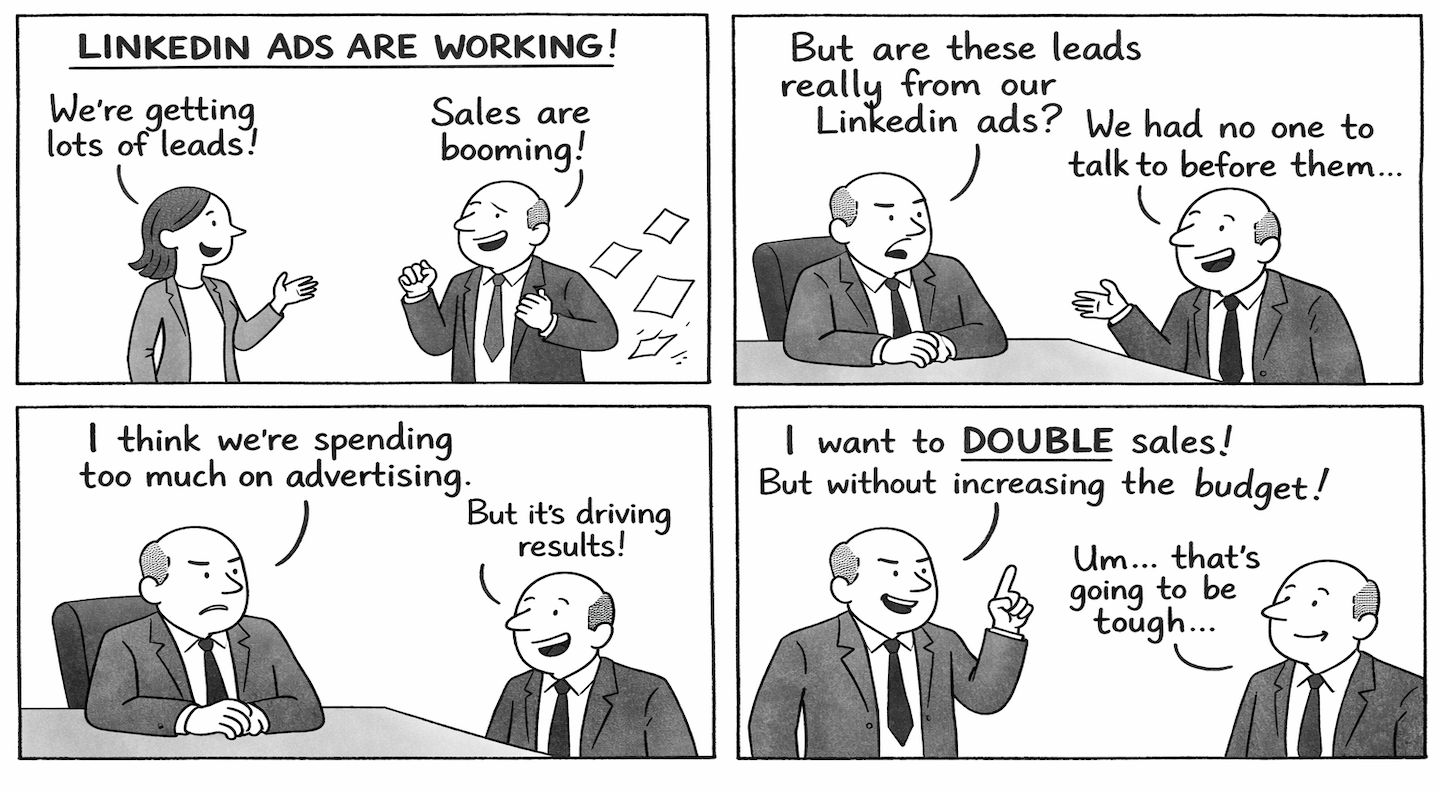
In a recent discussion with a client, their CEO asked a question that surfaces in many B2B companies once advertising budgets start to grow.
“Are these LinkedIn ads actually working?”
The question landed oddly because, from the perspective of the person actually selling, things were going well.
And in fact, since we started running their LinkedIn campaigns, we had been showing sales reps which target accounts were engaging and where to focus prospecting efforts.
So instead of chasing cold lists, the sales team could concentrate on companies already showing signs of interest.
Not surprisingly, their results improved. In fact, overall sales had been trending upward since the campaigns began.
Which made the CEO’s question—whether the ads were “actually working”—feel oddly disconnected from what was happening in the field.
The confusion came from the reporting.
The dashboard made the LinkedIn ad spend easy to see, but the attribution model only captured the last interaction before a prospect surfaced. In practice, that meant the CRM credited whatever happened at the end—a form submission, a phone call, an email reply—while the months of advertising that had been shaping awareness disappeared from view.
From the perspective of the report, the ads looked invisible even while sales conversations were increasing.
But the sales reps that were working accounts were seeing something very different.
The campaigns were revealing which companies were paying attention. Certain accounts kept appearing in the engagement data. People from those organizations were interacting with the messaging, visiting the site, and responding when outreach referenced the problem the ads had been highlighting.
Those signals gave the sales reps something far more useful than lists based on ideal client profiles (ICP) --they showed where they should be focusing their time.
Over time a pattern became clear: when outreach was directed toward accounts already interacting with the campaigns, conversations opened more easily.
Which raised a much more interesting question than whether the ads could be credited for a specific deal.
What were those campaigns revealing about which companies were beginning to question the status quo?

The Lead Generation Assumption
Most organizations still approach LinkedIn advertising with a familiar expectation: run campaigns, collect leads, and hand them to sales. If the leads turn into opportunities, the ads worked. If they don’t, something must be wrong with the targeting, the creative, or the platform itself.
That expectation makes sense if you’re thinking about channels built around buyer intent. When someone searches Google—or increasingly asks ChatGPT a question—they are actively looking for an answer or a solution. The moment already exists. The buyer has a problem and is trying to solve it.
LinkedIn doesn’t work that way.
People don’t open LinkedIn to search for vendors. They scroll through a feed. They read posts from colleagues. They notice ideas that catch their attention.
That means an ad first has to do something simple but difficult: stop the scroll.
Most LinkedIn ads fail at this. They read like brochure copy or product announcements, which makes them easy to ignore. Buyers move past them without a second thought.
But when an ad does stop the scroll, something different happens—it introduces a problem, reframes an assumption, or reminds someone of an issue they may already be struggling with.
That moment of recognition is where LinkedIn advertising begins to matter.
What Engagement Signals Actually Show
When marketers evaluate LinkedIn campaigns only by the leads they generate, they miss another source of insight those campaigns create.
Advertising on LinkedIn places an idea in front of a carefully defined audience. When that idea resonates, patterns begin to emerge.
Certain companies engage repeatedly with the same message. Particular job titles respond more consistently than others.
Those signals rarely translate immediately into form submissions. But they reveal something that is otherwise difficult to observe: which companies may already be grappling with the problem being described.
When the same accounts continue appearing in campaign engagement—liking posts, clicking ads, visiting the site—it often means the issue is already being discussed internally. The ads didn’t create the demand. They surfaced where the struggling moment may already exist.
And the person interacting with the ad is not necessarily the buyer.
In many organizations, that engagement comes from someone tasked with researching a problem on behalf of the company—an analyst, a manager, or a team member gathering information before the issue reaches leadership. A click from that person is not the opportunity itself, but it is a signal that the organization may be beginning to explore a solution.
For a sales rep, that signal changes the prospecting strategy.
Instead of reaching out blindly, the rep now knows which companies may be experiencing the issue. Outreach can begin across the account—connecting with multiple stakeholders, asking whether the problem described in the campaign is something the organization is currently dealing with, and referencing the interest that surfaced through the advertising.
This is where B2B marketing works very differently from consumer advertising.
Consumer ads often have to do the entire job themselves. They capture attention, persuade the buyer, and drive the purchase directly. The path from ad to sale is short, which makes attribution relatively easy.
B2B sales rarely unfold that way.
Complex products require someone to diagnose the problem, explain the implications, and prescribe a solution. That responsibility almost always falls to a salesperson. The advertisement’s role is not to close the deal but to surface the issue and reveal which organizations may already be feeling its effects.
Seen through that lens, LinkedIn campaigns begin to function less like a lead generator and more like a market signal.
And those signals have obvious implications for sales.
The Visibility Sales Actually Needs
Sales organizations constantly struggle with the same operational question:
Where should we focus our time?
Top-performing teams eventually reach the same conclusion: not all accounts deserve equal attention. Research in account-based marketing consistently shows that a relatively small group of accounts produces a disproportionate share of pipeline. In many organizations, the top 20 percent generate several times more pipeline value than the rest.
The challenge is identifying which accounts belong in that group.
This is where marketing signals become useful to sales.
When LinkedIn campaigns show that specific accounts are engaging with messaging around a particular problem, sales gains a practical advantage: a short list of companies where the issue may already be under discussion.
That insight changes how prospecting works.
Instead of working through cold lists, the sales rep can focus on accounts already showing signs of interest—reaching out across the organization, connecting with multiple stakeholders, and asking whether the problem highlighted in the campaign is something the company is actively trying to solve.
The advertisement does not create the opportunity. It simply points the sales team toward the accounts most likely to have one.
And for a salesperson deciding where to spend the next hour of their day, that visibility can be far more valuable than another lead.
Advertising as Market Feedback
LinkedIn campaigns also provide something marketing teams rarely obtain through other channels: rapid feedback about how the market perceives their message.
Inside most companies, debates about positioning can stretch on for weeks. Teams argue about which problems deserve emphasis, and which narratives will resonate with buyers. These discussions are thoughtful but theoretical.
Once campaigns run in the market, the answers arrive quickly.
Messages that seemed promising internally sometimes produce little engagement. Other ideas attract attention from precisely the companies the organization hopes to reach. Over time, these responses help marketing teams refine their understanding of which problems buyers actually care about.
Seen this way, LinkedIn advertising becomes an ongoing form of market research. Campaigns test ideas in the open market and reveal which problems attract attention from the intended audience.
For organizations trying to sharpen their positioning, that feedback can be just as valuable as the leads themselves.
Seeing the Whole Picture
So, when your leadership team asks: “Are these LinkedIn ads actually working?” they’re asking a reasonable question. Advertising is often the largest line item in the marketing budget, and leadership wants to know whether that investment is producing results.
Ultimately, that question usually comes down to one thing: customer acquisition cost (CAC). If ad spend pushes CAC beyond what the business model can support, something is out of balance. If CAC remains within acceptable limits while pipeline and revenue continue to grow, the investment is likely doing its job.
The difficulty is that the contribution of advertising rarely appears clearly in the reporting.
Most attribution models attempt to identify a single activity responsible for a deal. In B2B sales, that moment typically looks like a form submission, a meeting request, or an email reply. The CRM records that interaction and treats it as the beginning of the opportunity.
But that moment is usually just when the buyer becomes visible.
By the time someone fills out a form or schedules a meeting, the organization may already have been thinking about the problem for months. Messages have circulated. Internal conversations have started. Research has already begun.
Advertising often plays a role in that earlier stage—even when it never appears in the final attribution report.
This is why LinkedIn advertising can look disconnected from pipeline while sales teams are simultaneously finding more traction in the accounts they pursue.
The campaigns are not simply producing leads. They are revealing which companies may already be grappling with the problem you solve.
When teams begin looking at the data this way, the conversation changes. Instead of asking whether an ad directly created a deal, they begin asking:
- Which companies are engaging with the message?
- Which organizations appear to be exploring the problem?
- Where should the sales team focus their time?
Seen through that lens, LinkedIn advertising becomes less about isolated leads and more about understanding where demand may already be forming.
And that perspective helps leadership see something the dashboard alone often cannot--where the next sales conversation is most likely to begin.
Continue the Conversation
These questions about LinkedIn advertising rarely get resolved inside dashboards or attribution reports. They usually emerge in conversations between marketing, sales, and leadership teams trying to understand where pipeline is really coming from.
To explore these issues further, we’re hosting a small peer discussion with B2B marketing leaders.

LinkedIn Ads Roundtable: Using Ad Engagement to Identify Sales Opportunities
The session will take place on April 2 at 1:00 PM ET and will focus on how companies are interpreting engagement signals, connecting advertising activity to pipeline, and navigating the attribution challenges that often confuse these discussions.
Topics we’ll explore include:
- How teams are connecting LinkedIn ads to pipeline and revenue
- What engagement signals actually help sales prioritize accounts
- Why CEOs often question LinkedIn ad performance
- What attribution gets wrong about how deals really start
This will be a roundtable discussion rather than a webinar, so participants are welcome to share what they’re seeing in their own campaigns, ask questions, or simply listen to the conversation.
You can register here: https://bit.ly/3NjsYN9


